|
| A) | physicians, lawyers, policymakers, and legislators began to have questions about ethical issues in health care. | ||
| B) | scientific advances made it possible for patients to trust completely in their doctor's judgment, leaving no need for their own voice to be heard. | ||
| C) | there was a need to talk about how research and healthcare decisions and regulations could be made, who could make them, and what would be their long-term implications. | ||
| D) | Both A and C |
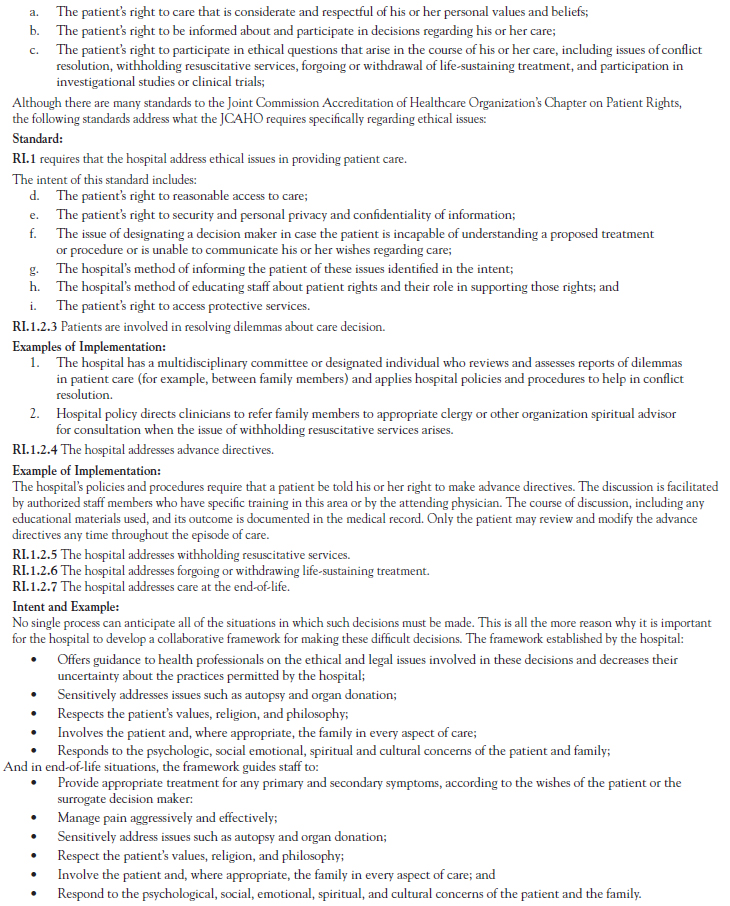
The blending of ethics, legalities, and medicine has come to be known as bioethics. The field of bioethics is a relatively new field. Its emergence into history came in the 1960s because there was a need to discuss how research and healthcare decisions and regulations could be made, who could make them, and what their long-term implications would be. In the late 1960s, philosophers, theologians, physicians, lawyers, policymakers, and legislators began to write about these questions, to hold conferences, to establish institutes, and to publish journals for the study of bioethics. In 1969, the Institute of Society, Ethics, and the Life Sciences was established at Hastings-on-the-Hudson, New York [1]. Two years later, the Kennedy Institute of Ethics was established at Georgetown University, Washington, DC [2].
| A) | nurse-centered. | ||
| B) | patient-centered. | ||
| C) | physician-centered. | ||
| D) | None of the above |
Prior to the 1960s, medical care decisions were part of the paternalistic role of physicians in our society. Patients readily acquiesced care decisions to their physicians because they were regarded almost as family. What drove this resolve of patients to acquiesce their medical care and treatment decisions to their physicians? Rothman believes physicians were given such latitude by their patients because they were well known and trusted by their patients and the community in which they practiced. There were no specialists. One physician took care of a patient and family for a lifetime. The frontier physician often knew the patient from birth to adulthood, made house calls, and was a family friend who knew best what the patient should do with a healthcare concern [3]. Since the 1960s, physicians have generally become strangers to their patients.
| A) | The Joint Commission, case law, and President Bill Clinton | ||
| B) | The Joint Commission, case law, and World War II research and experimentation | ||
| C) | World War II research and experimentation, presidential elections, and the Joint Commission | ||
| D) | World War II research and experimentation, increased medical technology, modernization of healthcare structure and organization |
The trend away from the family doctor making all the healthcare decisions toward a healthcare system replete with specialists, policy makers, ethical codes, administrative codes, and informed consent was brought about largely by three events in U.S. history. First, World War II research and experimentation (e.g., experimentation on concentration camp prisoners by the Nazis, research on atomic bomb survivors) brought attention to people as test subjects and what rights should be recognized on their behalf. Second, the modern structuring and organization in healthcare delivery moved patients from their familiar surroundings of home and neighborhood clinics to the often intimidating, large hospital. Third, the medical technologic boom brought life-saving interventions; people now live longer due to technology that allowed the discovery of treatment modalities, including the much acclaimed antibiotic therapies.
| A) | the Tuskegee experiment, the Willowbrook State School experiment, and the Belmont experiment. | ||
| B) | the Belmont experiment, the Los Alamos project, and the elderly patients with chronic illness injected with live cancer cells. | ||
| C) | elderly patients with chronic illness injected with live cancer cells, the Tuskegee experiment, and NutraSweet effects on teenagers. | ||
| D) | the Willowbrook State School experiment, the Tuskegee experiment, and the elderly patients with chronic illness injected with live cancer cells. |
Extensive publicity about three research projects resulted in the establishment of the National Commission for the Protection of Human Subjects of Biomedical and Behavioral Research [4]. The first project involved elderly patients with chronic illness who were injected with live cancer cells in an effort to discover whether the cells would survive in a person who was ill but did not previously have cancer. No consent was obtained from patients or family members before proceeding.
The second significant event began in 1932, when the Public Health Service initiated a syphilis study on 399 black men from Tuskegee, Alabama. The goal of the study was to observe the men over a period of time to examine how the disease progressed in individuals of African descent. When the study began, there was no cure for the disease; however, fifteen years into the study, penicillin was discovered to be a cure for syphilis. The research participants were never informed, and treatment was withheld in spite of the fact that by the end of the experiment in 1972, 128 men had died either from the disease or related complications [5].
Finally, in 1967, children with mental retardation at the Willowbrook State School, New York, were given hepatitis by injection in a study that hoped to find a way to reduce the damage done by disease. Although consent was obtained in this study, the consent sometimes had an element of coercion in that gaining admission to the school was difficult and parents were given a guarantee their child would be admitted if they consented to the participation of their child in the study [6].
| A) | Tuskegee case | ||
| B) | Nancy Cruzan case | ||
| C) | Karen Ann Quinlan case | ||
| D) | Protection of Human Subjects case |
It was the New Jersey Supreme Court Decision in the Karen Ann Quinlan case that brought bioethics to the level of the individual through the media and transformed physician paternalistic authority into patient-physician shared decision making [9]. As noted, patient autonomy issues came into public focus in the 1970s when the legal community set a precedent for deciding withdrawal/withholding of life-sustaining treatment. Although there were many related cases with decisions on medical treatment and decision making for competent and incompetent patients, two cases are recognized as landmark cases and were the most important in influencing the medical and legal community. These two cases were most responsible for moving the primary healthcare decision making into the arena of the individual. These court cases are the previously mentioned New Jersey Supreme Court Decision in the Matter of Karen Ann Quinlan (1976) and the U.S. Supreme Court Decision in the Matter of Nancy Cruzan [10]. From these two cases, and more specifically from the Nancy Cruzan case, the Patient Self-Determination Act of 1990 was enacted [11].
| A) | right to die. | ||
| B) | wrongful life. | ||
| C) | right to privacy. | ||
| D) | right to refuse care. |
Mr. Quinlan asserted that his daughter's right of privacy was justification for the request to terminate life support, and the court accepted the relevance of this right both to the treatment termination decision and to Mr. Quinlan's right to assert his daughter's right to privacy. In this way the court eliminated the issue of criminal homicide.
| A) | physician-assisted suicide. | ||
| B) | withdrawing of ventilator support from a permanently unconscious patient. | ||
| C) | removing an artificial feeding tube in a permanently unconscious patient. | ||
| D) | None of the above |
The Karen Ann Quinlan case is significant because it was the first case to deal specifically with the question of withdrawing ventilator support from a permanently unconscious patient. It is often cited as a source for the importance of the privacy right in life and death decisions.
| A) | the withdrawing of ventilatory support. | ||
| B) | the removal of an artificial feeding tube. | ||
| C) | the family members spoke for the individuals. | ||
| D) | None of the above |
In 1983, Nancy Cruzan presented to the local hospital in a comatose state, a result of an automobile accident that left her in a persistent vegetative state (PVS). What links Ms. Cruzan's case to the principle of the patient's autonomy (and subsequently to issues of right to die) and to the Karen Ann Quinlan Case is the fact that neither individual could speak for herself once the actual situation requiring a decision presented itself. Therefore, the two cases are linked by the fact that family members went forward to speak for the individuals.
| A) | incompetent patients have the same rights as competent patients. | ||
| B) | the decision-making process should never occur in the clinical setting. | ||
| C) | the right to refuse treatment is an issue to be decided at the state level. | ||
| D) | artificial nutrition and hydration is not considered a medical treatment. |
Over the years, from the Quinlan and Cruzan cases to the many others (including the more recent Schiavo case) that address patients' rights to refuse treatment and the idea of who can speak for incompetent patients, state courts began to address the issues explicitly. Multiple states reached substantial agreement that:
Competent patients have a constitutional and common-law right to refuse treatment.
Incompetent patients have the same rights as competent patients.
The interests of the state opposing this right are virtually nonexistent in the case of competent patients and very weak in the case of incompetent patients whose prognosis for recovery is dim.
The decision-making process should generally occur in the clinical setting without resort to the courts, which are available to assist in decision making when an impasse is reached.
In making decisions for incompetent patients, surrogate decision makers should effectuate the patient's own preferences expressed before the patient lost decision making capacity (the subjective standard); however, if these preferences are not known, the surrogate, based on whatever evidence is available, should approximate what the patient would have wanted (the substituted judgment standard). If there is not information about the patient's preferences, the surrogate should make a decision that is in the patient's best interests (the best interests standard).
In ascertaining an incompetent patient's preferences, the attending physician and surrogate may rely on the patient's "advance directive," which may be written or oral.
Artificial nutrition and hydration are medical treatments and may be withheld or withdrawn under the same conditions as any form of medical treatment.
| A) | state level. | ||
| B) | federal level. | ||
| C) | county level. | ||
| D) | hospital level. |
Although this multi-state consensus was not without exception, these were the precursor principles to the PSDA of 1990, the federal law given over to the states to implement as of December 1, 1991 [11]. This new legislation applied to hospitals, nursing homes, hospice, HMOs/PPOs, and any other facilities that receive funds from Medicare or Medicaid programs. It further mandated that each of the affected facilities must advise their patients of their legal rights and options for accepting or refusing treatment if they (the patients) should become unable to speak for themselves. The primary provisions of the PSDA are:
Providers must offer written information and summaries of pertinent institutional policies to all adult patients regarding their rights under state laws to accept or refuse treatment and to make advance directives.
The patient's record must be documented to indicate whether the patient has an advance directive.
Institutions may not discriminate against or offer or refuse care to a patient based upon whether the patient has executed an advance directive.
Institutions have an affirmative obligation to comply with requirements of state law regarding advance directives.
Institutions must provide (individually or with others) education to staff and community regarding issues associated with advance directives.
State Medicaid laws must be amended to require participating healthcare institutions to furnish the written information mentioned above.
With the Department of Health and Human Services' assistance, state Medicaid agencies must develop written descriptions of state laws on advance directives, and these materials are to be distributed by participating healthcare institutions.
| A) | require clients to make out a living will. | ||
| B) | provide staff and the community education regarding issues associated with advance directives. | ||
| C) | halt care if there is not specific knowledge of the availability of an advanced directive for the patient in need of care. | ||
| D) | All of the above |
Although this multi-state consensus was not without exception, these were the precursor principles to the PSDA of 1990, the federal law given over to the states to implement as of December 1, 1991 [11]. This new legislation applied to hospitals, nursing homes, hospice, HMOs/PPOs, and any other facilities that receive funds from Medicare or Medicaid programs. It further mandated that each of the affected facilities must advise their patients of their legal rights and options for accepting or refusing treatment if they (the patients) should become unable to speak for themselves. The primary provisions of the PSDA are:
Providers must offer written information and summaries of pertinent institutional policies to all adult patients regarding their rights under state laws to accept or refuse treatment and to make advance directives.
The patient's record must be documented to indicate whether the patient has an advance directive.
Institutions may not discriminate against or offer or refuse care to a patient based upon whether the patient has executed an advance directive.
Institutions have an affirmative obligation to comply with requirements of state law regarding advance directives.
Institutions must provide (individually or with others) education to staff and community regarding issues associated with advance directives.
State Medicaid laws must be amended to require participating healthcare institutions to furnish the written information mentioned above.
With the Department of Health and Human Services' assistance, state Medicaid agencies must develop written descriptions of state laws on advance directives, and these materials are to be distributed by participating healthcare institutions.
| A) | prime directive. | ||
| B) | advance directive. | ||
| C) | last will and testament. | ||
| D) | financial durable power of attorney. |
Finally, legislation was created to keep end-of-life medical decision-making issues out of the courts and in the appropriate arena, with the appropriate players: the patient/family and the healthcare professionals. The central focus of the law is the provision of patient education. The means or the tools for the individual to document his or her wishes for future healthcare decisions is called an advance directive. There are two types of advance directives available. Although both are not required to be completed together, most people are encouraged to do so.
| A) | patients to write their own treatment orders on the physician order form. | ||
| B) | patients to document their treatment wishes should they become unable to speak for themselves. | ||
| C) | the named surrogate to act on the financial matters of the patient who is unable to speak for himself/herself. | ||
| D) | the patient to name an attorney-in-fact to act on behalf of him/her for healthcare decisions, should the patient become unable to speak for himself/herself. |
The first type of advance directive is called a physician directive, sometimes called directive to physician [12]. The precedent form is the living will, an earlier, legally non-binding form. The living will allowed an individual to state his/her treatment choices should he or she be found in a terminal state, comatose, and/or in another condition leading to imminent death for which the physician saw no cure. The patient stated that he/she be allowed to die naturally without medical intervention, with only comfort measures employed.
| A) | advance directives. | ||
| B) | ethical issues in providing care. | ||
| C) | patient involvement in care decisions. | ||
| D) | All of the above |
| A) | a real or perceived conflict of values and beliefs. | ||
| B) | only found in situations regarding withdrawing of life-support. | ||
| C) | the nurse and the physician do not communicate well with the patient. | ||
| D) | None of the above |
How do we then go from theoretical ethics to the day-to-day practical application of those principles in today's high-tech society? It really boils down to a deductive reasoning process. The process starts with the broad and general, often abstract global ideas of how people should act rightly within society. Then, the process narrows in focus to a smaller group or individual situation in which the ethical principles act as a guide for daily living. Further, when a situation presents itself that contradicts the "norm," it may cause a dilemma. When these dilemmas are of an ethical nature, we often say the situations are controversial or called into question or infringed upon a group or individual's rights based upon accepted ethical theories and moral practices.
How does one move from the general ethical concepts, based on religious or philosophical theoretical frameworks discussed later in this course, and apply them practically to patient/society healthcare decision making? Generally, an ethical conflict presents itself when a person's or group's ethical values or principles are challenged or conflict with one another. It is imperative to identify what principles or values are in conflict so that an appropriate resolution can be made.
A dilemma occurs when one is faced with what is perceived (or is in reality) to be no alternative, only one alternative, or an either/or choice situation. This dilemma scenario leaves the individual with limited, often painful choices. "Have the surgery or die," may be the only two alternatives given to a patient. This can leave the patient immobilized, powerless, feeling subservient and victimized, and with no sense of control.
| A) | Negotiating, harboring, enlisting, issuing, delegating, acceptance | ||
| B) | Denial, anger, resistance, bargaining, acceptance, enlisting, issuing | ||
| C) | Autonomy, beneficence, non-maleficence, fidelity, right-to-know, justice, veracity | ||
| D) | Automotive, benevolent, non-benevolent, finality, wrong-to-know, judicious, veracity |
With this information gathered, it should be apparent whether or not a value conflict exists. Many times, just the process of gathering information allows for clarification and for differences to be resolved. If an ethical conflict ensues, the next step is to articulate the ethical principles that are opposing one another. The most common ethical principles involved in healthcare settings today are patient autonomy, beneficence, non-maleficence, fidelity, right-to-know, justice, and veracity (Table 1).
| A) | autonomy and justice. | ||
| B) | fidelity and autonomy. | ||
| C) | veracity and non-maleficence. | ||
| D) | autonomy and self-determination. |
THE MOST COMMON PRINCIPLES CURRENTLY APPLIED IN HEALTHCARE DECISION MAKING
| Principle | Definition |
|---|---|
| Autonomy | The principle of self-determination, freedom of choice |
| Beneficence | The duty to do good and avoid harm; respectful, compassionate |
| Non-maleficence | The duty not to harm, not treated as a means to an end |
| Fidelity | The making and keeping of promises |
| Right-to-Know | The informed consent principle |
| Justice | The principle of fairness, treating people in similar circumstances similarly, nondiscrimination |
| Veracity | The principle of truth telling and integrity |
| A) | the principle that all people are not of equal value. | ||
| B) | a little white lie is okay if it is seen to be in the person's best interest. | ||
| C) | based upon the principle that people should always be treated as means to an end. | ||
| D) | a system of ethical decision making that stands on moral rules and unwavering principles. |
Under the deontologic umbrella, an action is deemed right or wrong according to whether it follows pre-established criteria known as imperatives. An imperative in our language is viewed as a "must do," a rule, an absolute, a black and white issue. This is an ethic based upon duty linked to absolute truths set down by specific philosophical schools of thought. As long as the principles dictated by these imperatives are met with dutiful compliance, one is said to be acting ethically [18].
| A) | Pragmatism | ||
| B) | Utilitarianism | ||
| C) | Existentialism | ||
| D) | Theory of Justice |
One of the most significant features of deontologic ethics is found in John Rawls' Theory of Justice, which states that every person of equal ability has a right to equal use and application of liberty [19]. However, certain liberties may be at competition with one another. There are also some principles within the same ethical theoretical system that can conflict with one another. An example of this conflict might involve a decision over allocation of scarce resources. Under the principle of justice, all people should receive equal resources (benefits), but allocation can easily become an ethical dilemma when those resources are scarce.
| A) | It is known as the virtue system of ethics. | ||
| B) | The fundamental maxim is to do good and avoid evil. | ||
| C) | Both A and B | ||
| D) | None of the above |
Natural law ethics, also known as the virtue system of ethics, is a system in which actions are seen as morally or ethically correct if in accord with the end purpose of human nature and human goals. The fundamental maxim of natural law ethics is to do good and avoid evil. Although similar to the deontologic theoretical thought process, it differs in that natural law focuses on the end purpose concept. Further, natural law is an element in many religions while at its core it can be either theistic or non-theistic.
| A) | an ethic of caring. | ||
| B) | a holistic framework in an environment of differing values, beliefs, and ethical principles. | ||
| C) | Both A and B | ||
| D) | None of the above |
The final ethical theory to be discussed here is the modern ethical system of thought that centers on the diversity of cultures and beliefs. Therefore, at its core, this ethic assumes that all discourse and interaction is transcultural because of the strengths and differences in values and beliefs of groups within society. This concept has been developed into what has become known as the transcultural ethical theory.
In the last decade, the ethics of caring has become a specific moral focus of nursing. Attention is being paid to the need for cross-cultural ethical issues in both medicine and nursing. The concept of transcultural nursing was penned by Dr. Madeleine Leininger and focuses on a comparative analysis of differing cultures, health-illness values, patterns, caring behavior, and nursing care [29]. Decisions are made on the basis of the value or worth of someone by the quality of inter-relationships.
These differences of values, beliefs, or ethical principles are present in healthcare environments. They are much more pronounced when the individuals' values differ greatly from those of the healthcare professionals who care for them. This system of ethics is a holistic framework, built around a model of interrelated precepts: transcultural caring dynamics, principles, transcultural context, and universal source. These precepts form the foundation for facilitating the transcultural ethical decision making (Figure 2).
| A) | anger, shock, adapting, and balancing. | ||
| B) | principles, precepts, rules, and guidelines. | ||
| C) | adapting, adjusting, diversifying and acting. | ||
| D) | caring dynamics, principles, context, and universal source. |
These differences of values, beliefs, or ethical principles are present in healthcare environments. They are much more pronounced when the individuals' values differ greatly from those of the healthcare professionals who care for them. This system of ethics is a holistic framework, built around a model of interrelated precepts: transcultural caring dynamics, principles, transcultural context, and universal source. These precepts form the foundation for facilitating the transcultural ethical decision making (Figure 2).
| A) | of financial interest. | ||
| B) | where clear demarcations do not exist. | ||
| C) | where the nurse's license is in question. | ||
| D) | None of the above |
The chief goal of an ethical decision-making framework is to determine right from wrong in situations where clear demarcations do not exist or are not readily apparent to the nurse who is faced with the decision. Nurses must clarify their own values and subscribe to a particular ethical system or theory before an ethical decision-making framework can be used successfully. A framework provides a method for nurses to answer key questions about the dilemma and to organize their thinking in a more logical and clear manner. There are several forms that ethical decision-making frameworks can take. They are all based on the scientific or problem-solving method that forms the basis for the nursing process. The problem-solving model is the basis for the ethical decision-making framework that follows.
| A) | subscribe strictly to one ethical system. | ||
| B) | clarify her or his own values and subscribe to a particular ethical system or theory. | ||
| C) | take numerous courses on ethical theory and be able to define each theoretical system. | ||
| D) | None of the above |
The chief goal of an ethical decision-making framework is to determine right from wrong in situations where clear demarcations do not exist or are not readily apparent to the nurse who is faced with the decision. Nurses must clarify their own values and subscribe to a particular ethical system or theory before an ethical decision-making framework can be used successfully. A framework provides a method for nurses to answer key questions about the dilemma and to organize their thinking in a more logical and clear manner. There are several forms that ethical decision-making frameworks can take. They are all based on the scientific or problem-solving method that forms the basis for the nursing process. The problem-solving model is the basis for the ethical decision-making framework that follows.
| A) | the honor method. | ||
| B) | the Hippocratic method. | ||
| C) | the prime directive method. | ||
| D) | the scientific or problem-solving method. |
The chief goal of an ethical decision-making framework is to determine right from wrong in situations where clear demarcations do not exist or are not readily apparent to the nurse who is faced with the decision. Nurses must clarify their own values and subscribe to a particular ethical system or theory before an ethical decision-making framework can be used successfully. A framework provides a method for nurses to answer key questions about the dilemma and to organize their thinking in a more logical and clear manner. There are several forms that ethical decision-making frameworks can take. They are all based on the scientific or problem-solving method that forms the basis for the nursing process. The problem-solving model is the basis for the ethical decision-making framework that follows.
| A) | is useful after thoughts have been organized. | ||
| B) | is not very dynamic and useful in day-to-day situations. | ||
| C) | does not depend on a set of static rules that are unchanging. | ||
| D) | None of the above |
Although ethical dilemmas and the decision-making skills involved in resolving these dilemmas are complex and multifaceted, mastery of these skills is well within the capability of the healthcare professional. The specialty area of ethical decision making, like most other specialties, has its own language and terminology that must be understood and mastered. However, the science of ethical decision making does not depend on a set of static rules that are unchanging. Ethical decisions are based on a framework of ethics that is dynamic and useful in day-to-day situations.
| A) | that a system of ethics exists. | ||
| B) | the content of the ethical system. | ||
| C) | that the system applies to similar ethical decision-making problems despite multiple variables. | ||
| D) | All of the above |
In their professions, nurses and physicians are frequently taught to apply very strict standards in the determination of patient capacity or ability to make decisions. A framework for ethical decision making presupposes that nurses and physicians making decisions know that a system of ethics exists, the content of that ethical system, and that the system applies to similar decision-making problems despite the multiple variables. As an example, many institutions have adopted policies that do not allow a medicated patient to sign consent forms within a specified time. But the chronic pain management patient on continuous narcotic pain control may not have the capacity of reason.
| A) | certified by a judge as competent. | ||
| B) | able to converse with healthcare staff. | ||
| C) | proven to make healthy and correct decisions. | ||
| D) | able to understand information relevant to the decision at hand and be able to weigh the possible alternatives. |
From an ethical point of view, the patient is a capable decision maker if he or she can understand information relevant to the decision at hand, interact and communicate with caregivers about the decision, and weigh the possible alternatives. A general checklist on which to set up an ethical framework comes from Judith Ross. One might abide by the following steps [39]:
Collection of a database
Case presentation
Identification of medical problems
Identification of psychological problems
Identification of an ethical dilemma
Identification of legal or policy issues
Discussion of ethical issues
Suggestions for approaches to problems
Discussion with initiator, patient, if possible, and other individuals directly involved with specific patient or problem
Documentation of issues discussed and suggested approaches to be placed in the patient's chart, including written summaries
| A) | The nurse | ||
| B) | The physician | ||
| C) | The patient/family | ||
| D) | An objective outside party |
Whenever possible, the patient/family makes the final healthcare decision. The first and most important step is to gather and assess the facts. The nurse can be instrumental in facilitating the stages of ethical action. The following is a general outline of each step and process that develops as one moves through the steps. In each step, questions are offered to help the healthcare professional gather all the information necessary to assist the patient and healthcare team in the decision-making process.
| A) | brainstorming ethical terms. | ||
| B) | identifying the values in conflict. | ||
| C) | differentiating facts from values and policy issues. | ||
| D) | taking action and communicating what needs to be done. |
There are five fundamental components to the cognitive decision-making process as identified by ethicists Kenyon and Congress. They encompass naming the dilemma, sorting the issues, solving the problem, acting, and evaluating and reflecting [40,41]:
Naming the dilemma involves identifying the values in conflict. If they are not ethical values or principles, it is not truly an ethical dilemma. It may be a communication problem or an administrative or legal uncertainty. The values, rights, duties, or ethical principles in conflict should be evident, and the dilemma should be named (e.g., this is a case of conflict between patient autonomy and doing good for the patient). This might happen when a patient refuses an intervention or treatment that the nurse thinks would benefit the patient. When principles conflict, such as those in the example statement above, a choice must be made about which principle should be honored.
Sort the issues by differentiating the facts from values and policy issues. Although these three matters often become confused, they need to be identified, particularly when the decision is an ethical one. So, ask the following questions: what are the facts, values, and policy concerns, and what appropriate ethical principles are involved for society, for you, and for the involved parties in the ethical dilemma?
Solve the problem by creating several choices of action. This is vital to the decision-making process and to the patient's sense of controlling his or her life. When faced with a difficult dilemma, individuals often see only two courses of action that can be taken. These may relate to choosing an intervention, dealing with family and friends, or exploring available resources. It is good to brainstorm about all the possible actions that could be taken (even if some have been informally excluded). This process gives everyone a chance to think through the possibilities and to make clear arguments for and against the various alternatives. It also helps to discourage any possible polarization of the parties involved. Ethical decision making is not easy, but many problems can be solved with creativity and thought. This involves the following:
Gather as many creative solutions as possible by brainstorming before evaluating suggestions (your own or others).
Evaluate the suggested solutions until you come up with the most usable ones. Identify the ethical and political consequences of these solutions. Remember that you cannot turn your ethical decision into action if you are not realistic regarding the constraints of institutions and political systems.
Identify the best solution. Whenever possible, arrive at your decision by consensus so that others will support the action. If there are no workable solutions, be prepared to say so and explain why. If ethics cannot be implemented because of politics, this should be discussed. If there are no answers because the ethical dilemma is unsolvable, the appropriate people also must be informed. Finally, the patient and/or family should be involved in making the decision, and it is imperative to implement their choice.
Initiate and act because ethics without action is just talk. In order to act, make sure that you communicate what must be done. Share your individual or group decision with the appropriate parties and seek their cooperation. Implement the decision.
Evaluate and reflect, as perfect ethical decisions are seldom possible. However, healthcare professionals can learn from past decisions and try to make them better in the future, particularly when they lead to policy making. To do this:
Review the ramifications of the decision.
Review the process of making the decision. For example, ask yourself if you would do it in the same way the next time and if the appropriate people were involved.
Ask whether the decision should become policy or if more cases and data are needed before that step should occur.
Learn from successes and errors.
Be prepared to review the decision at a later time if the facts or issues change.
| A) | Some people skip the lower stages in moral development. | ||
| B) | A person at one stage can understand any stage below him or her. | ||
| C) | A person at one stage can understand any stage above him or her. | ||
| D) | None of the above |
Kohlberg presumes that there are six stages of moral development that individuals advance through in much the same way that infants learn first to roll over, to sit up, to crawl, to stand, and finally to walk. There are two important correlates of Kohlberg's system [39]:
Everyone goes through each stage in the same order, but not everyone goes through all the stages.
A person at one stage can understand the reasoning of any stage below him or her but cannot understand more than one stage above.
| A) | "If I do not make that decision, I will be punished." | ||
| B) | "If I make that decision, I will be rewarded and other people will help me." | ||
| C) | "This decision will contribute to social well-being, and, as members of a society, we have an obligation to every other member." | ||
| D) | "Others whom I care about will be pleased if I do this because they have taught me that this is what a good person does." |
Stage 5: Here, the decision maker justifies decisions by explaining that acts will contribute to social well-being and that each member of society has an obligation to every other member.
Stage 6: At this final stage decisions are justified by appeals to personal conscience and universal ethical principles.
It is important to understand that Kohlberg's stages do not help to find the right answers, as do ethical theories. Instead, recognizing these stages help us to know how people arrive at decisions. As a result, if the same question was asked of someone at each of the six levels, the answer might be the same in all cases, but the rationale for the decision may be different. For example, let us suppose we are caring for a terminally ill man in great pain who is asking the doctor or the nurse for enough barbiturates to commit suicide. Here are examples of the rationale for the healthcare professional's decision and reply in each stage.
Stage 1: "No, because I could lose my license if anybody found out I had done that."
Stage 2: "No, because if I became known as a doctor or nurse who did that kind of thing, other doctors and nurses might not refer patients to me."
Stage 3: "No, because that is against the law and professionals should obey the law," or "No, because my colleagues would no longer respect me if they knew I had done that."
Stage 4: "No, because if everyone did that, the doctors and nurses would no longer be trusted to save lives."
Stage 5: "No, even though the patient might suffer less, we need to be faithful to our respect for life because otherwise we might lose our standards and abuse our authority."
Stage 6: "No, because I personally believe that no one has a right to take his or her own life, and so I cannot be a party to such an action."
| A) | bioethics. | ||
| B) | business ethics. | ||
| C) | Socratic ethics. | ||
| D) | Platonic ethics. |
Every profession that deals with human rights and liberties eventually develops professional ethics (either formally or informally) to guide the responsible behavior of its members. In healthcare, the deductive process by which ethical principles are applied to situations common to the profession is called bioethics. It is a branch of applied ethical theory at least as old as the Hippocratic Oath and as current as the dilemmas posed by the unique clinical practice of today.
| A) | relatives should know what is best for their loved ones. | ||
| B) | health professionals understand what is best for their patients. | ||
| C) | the patient's decision is to be the final say in what will be his or her treatment plan. | ||
| D) | All of the above |
Paternalism sees the nurse urging patients to choose treatment plans based on the physician's idea of best interest. Paternalism is the view that professionals understand the patient's best interest better than the patient and are entitled to act so that a patient's well-being is promoted, even if the patient does not agree. In certain cases, individual liberties might be compromised in favor of the superior judgment of healthcare workers.
| A) | ethics of caring. | ||
| B) | paternalistic ethics. | ||
| C) | ethics of truth telling. | ||
| D) | ethics of consumerism. |
This sharing of beliefs between patient and nurse is the ethics of caring as proposed in the holistic nature of nursing. Caring allows the nurse more of an involved role than consumerism, as nurses and patients share, rather than enforce, their different convictions about life and death. At the same time, caring stops short of paternalism in that the nurse merely illustrates how to make an ethical decision by applying her own ethical principles. The primary goal is to empower the patient to make his or her own decision. It is essential that the nurse be able to understand her own ethical systems and to place those of her patient within proper perspective, even if they are different from her own, all without being judgmental. In this way, the ethics of caring makes clear how ethical decision making has become so central for nursing.
| A) | facility and community resources. | ||
| B) | legal parameters regarding your policy issue. | ||
| C) | administrative parameters regarding your policy issue. | ||
| D) | All of the above |
When developing policy of any kind, it is important to research the state statutes that apply to the agency policy information, ensuring that it is in sync with the law. Also, use the community's similar agencies as resources. Find out if they have similar policies or guidelines that they would be willing to share. Most facilities are willing to share this kind of information. Use your own agency resources; a risk manager, ethics consultant, or ethics committee can be very helpful. The following is an example of a policy for ethical decision making in patient care that can be used and/or adapted for your agency's use.
| A) | The family and the physician only | ||
| B) | The patient and his/her doctor only | ||
| C) | The interdisciplinary healthcare team only | ||
| D) | The patient, family or significant other, and the interdisciplinary healthcare team |
As any ethical situations arise, the team member should:
Continue to include the patient and family in the patient's plan of care. Discussion of the patient's feelings about his or her condition, treatment, values, and spiritual, psychosocial, and cultural beliefs should be encouraged to assist the individual nurse and other members of the patient's healthcare team to provide the best care for the patient. It should be determined whether there exists a communication breakdown.
Any information obtained should be considered confidential to all except those involved directly in the care of the patient.
Documentation of information obtained should be placed in the patient's record, the primary medical provider shall be notified, and any resulting orders obtained and recorded.
If no conflict arises between the patient's wishes and those of the healthcare team members involved in the care of the patient, and the patient's requests are legally sanctioned by state and federal law and within institutional policy guidelines (i.e., through the patient's advance directive), the patient's wishes shall be followed.
If an ethical conflict arises involving a patient, the nurse (or administrative person) in charge of the patient's care shall identify the ethical problem and the persons at conflict (e.g., patient and physician, patient and family, family and physician, or any combination of persons directly involved in the patient's care).
If the person who reports the conflict is the patient, the nurse should initiate a discussion with the patient to identify the problem to determine if the conflict involves anyone other than the patient. If information, including patient's rights, is all that is requested, the nurse should discuss the issues with the patient and family (if available) and document the patient's wishes in the medical record. The physician shall be notified of such, and any resulting physician orders shall be obtained and documented.
If the conflict involves a patient and physician, the nurse shall attempt to encourage discussion between the patient and family to ascertain their feelings and call the physician to obtain a response to the patient's wishes and concerns. All discussion with the patient and physician shall be documented.
The nurse in charge of the patient's care shall discuss the conflict with the manager (supervisor or administrator) for collaboration. Unit staff meetings may be utilized as a discussion base and education about ethical conflicts that may arise on the individual unit.
| A) | random observation of life expectancies. | ||
| B) | routing opinions to learned environments. | ||
| C) | risky developments, open to suggestion, lifestyle, extenuating circumstances. | ||
| D) | risks of medical treatment, opinion of the patient, life quality, external factors. |
Using the acronym R.O.L.E. as their framework, note that the authors identify the same decision-making issues as the framework and algorithm examples discussed in this course.
R: Risks of medical treatment. In this case the proposed treatment bears little risk to the patient. Few people have life-threatening complications from laceration repair; therefore, the chance of the patient experiencing untoward harm from the procedure is remote.
O: Opinion of the patient. Why does the patient want to leave the emergency department? Does he understand the risks and benefits of the procedure? Is he competent to make this decision in his intoxicated state?
L: Life quality. Will not having the laceration repaired significantly affect the patient's quality of life? Would an unsutured wound healing for an extended period affect the patient in his profession and render him unable to earn a living? For example, would he be unable to wear required safety equipment, such as a helmet or goggles, because of the laceration? Is the patient involved in a profession, such as acting, where a potentially disfiguring scar could affect his career?
E: External factors. Is there any obligation on the part of the healthcare team to third parties (i.e., those who may be traveling at the same time as the patient and who may be endangered from a safety standpoint)?
| A) | Feelings | ||
| B) | The law | ||
| C) | Ethical principles | ||
| D) | The father's request |
Upon returning to the unit, you talk with your supervisor, who listens carefully and questions you at length. Finally, she says, "It seems as if you have nothing concrete to act upon and are only experiencing feelings. I think you would be risking a lot of trouble for yourself and the hospital if you acted rashly at this time. Accusing people with no evidence and making them go through a traumatic experience is something I would hesitate to do."
| A) | The school holds the full responsibility. | ||
| B) | The hospital holds the full responsibility. | ||
| C) | The student holds the full responsibility. | ||
| D) | Both the school and the hospital hold full responsibility. |
From the Journal of Nursing Administration, we find a case to study regarding the public and professional responsibility of hospitals [46]. Hospitals throughout the country are held in high esteem within their communities for public service. They earn the public's trust by providing safe, good quality patient care. Many community hospitals serve as teaching sites for students' practicum programs, as did the hospital in this case study. Health facilities also have an obligation to share the responsibility for the quality of the nursing program by providing practice sites and nursing role models. In the case presented, the hospital should have been more proactive in addressing the quality of this practice issue.